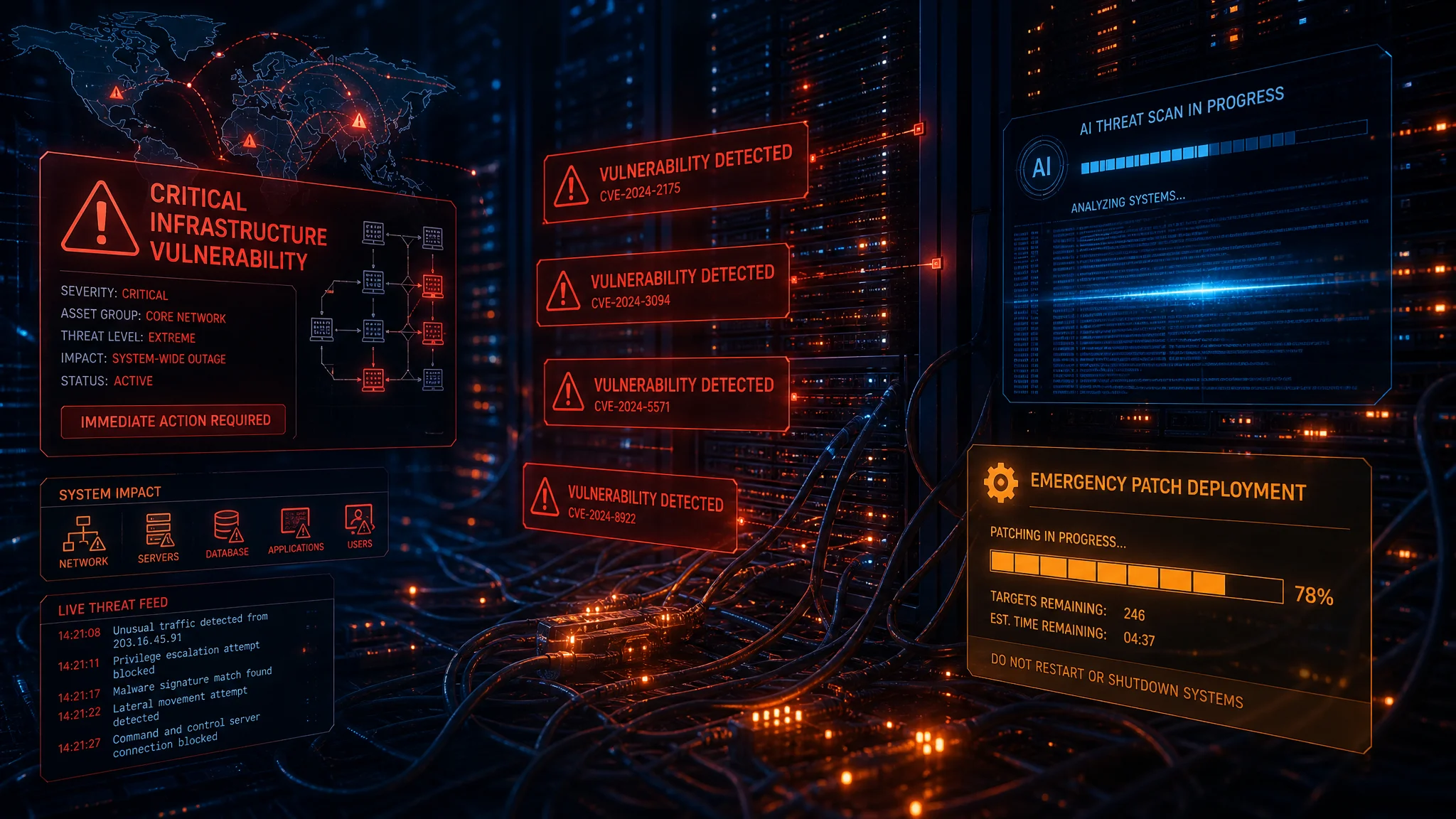
The internet has been running on borrowed time. For decades, organizations built their digital infrastructure on foundational software — web servers, encryption libraries, database engines, operating system kernels — written years or even decades ago, when security was an afterthought and code reviews were manual. That debt is now being called in all at once, and AI is the auditor.
A recent New York Times investigation examined how artificial intelligence is accelerating the discovery of long-buried software vulnerabilities, triggering a chaotic wave of emergency patching that is disrupting critical digital infrastructure worldwide. Industry analysts are calling the phenomenon a "digital deficit" coming due — and warning that the rush to remediate foundational code at machine speed will cause recurring service outages over the next year to eighteen months.
What is the "digital deficit"?
Software development has always involved trade-offs. Ship now, secure later. Feature parity over code audit. The result is that vast portions of the internet run on code that was written before modern security practices existed — and in many cases, by developers who are no longer available to explain it.
Until recently, this debt was manageable because finding vulnerabilities in legacy code was slow, manual, and expensive. Security researchers had to read source code line by line, fuzz test binaries, and rely on intuition. It was a human-speed process facing a machine-scale problem.
AI changed the equation. Large language models trained on code can now scan millions of lines of legacy C, Fortran, and assembly in hours, flagging buffer overflows, use-after-free bugs, and logic errors that have sat dormant for years. Automated fuzzing frameworks powered by reinforcement learning explore edge cases that human testers would never think to try. The result is a flood of new CVEs in software that everyone assumed was safe because it had "worked fine for 20 years."
Finding and fixing vulnerabilities is objectively good. But when decades of latent bugs are discovered simultaneously and patched under emergency pressure, the patches themselves introduce risk. Hasty fixes break compatibility, miss edge cases, and sometimes introduce new vulnerabilities. The cure can sicken the patient.
Why patching is breaking things
When a vulnerability is found in foundational software — say, a widely-used TLS library or a core DNS resolver — the pressure to patch is immense. Every day the patch goes unapplied is a day attackers can exploit the flaw. But emergency patching has serious downsides:
- Compatibility breakage: Patches that fix security flaws often change behaviour that downstream systems depend on. A fix for a buffer overflow in a compression library can break every application that relied on the old (insecure) behaviour. These dependencies are often undocumented and unknown until something breaks.
- Cascading failures: Modern infrastructure is deeply interconnected. Patching one component can trigger failures in upstream services that cascade across providers. The CrowdStrike outage of 2024 showed how a single faulty update can ground airlines, halt hospital operations, and disrupt payment systems globally.
- Insufficient testing windows: Best practice says you test patches in staging before deploying to production. When a critical CVE drops on a Friday afternoon with active exploitation in the wild, that window collapses to hours — or minutes. Untested patches reach production, and the blast radius grows.
- Patch fatigue: When every week brings a new critical vulnerability, IT teams triage by urgency. Less-critical patches stack up, technical debt compounds, and the next emergency hits a system that's already behind on updates.
The timeline: what to expect over the next 18 months
Industry analysts quoted in the NYT coverage suggest we are entering a sustained period of infrastructure instability. The expectation is not a single catastrophic event, but rather a drumbeat of outages — some minor, some significant — as the industry works through its accumulated security debt.
| Phase | Timeline | What to expect |
|---|---|---|
| Discovery surge | Now – Q2 2027 | AI tools find vulnerabilities faster than they can be patched. CVE counts spike. Patch backlogs grow. Prioritization becomes critical. |
| Patching chaos | Q1 2027 – Q3 2027 | Organizations patch under pressure. Compatibility issues surface. Service outages increase. Some patches are recalled or revised multiple times. |
| Stabilization | Q3 2027 – Q1 2028 | Backlog shrinks. Patching processes mature. AI-assisted patching tools reduce human error. Outage frequency declines toward baseline. |
| New normal | Q1 2028 onward | Continuous AI-driven vulnerability discovery becomes standard. The deficit is resolved, but the cadence of discovery and patching remains higher than the pre-AI era. |
What Canadian businesses should do
For Canadian SMBs, the digital deficit creates two risks: direct vulnerability to attacks, and indirect disruption from outages caused by patching gone wrong. Here's how to prepare:
You can't patch what you don't know about. Inventory every piece of software in your environment — including embedded libraries, firmware, and third-party dependencies. Many organizations discover critical vulnerabilities in software they didn't even know was installed.
Resist the urge to patch everything immediately. Prioritize by exposure: internet-facing systems first, then internal systems, then isolated environments. Test patches in a staging environment that mirrors production. Even a 24-hour testing window dramatically reduces the risk of a bad patch.
Even if your own patching is flawless, your cloud provider, DNS host, or payment processor might break. Have a plan for:
- Communication: How will you reach clients if your primary tools are down? (Hint: a phone tree doesn't depend on the internet.)
- Revenue continuity: Can you process payments offline? Do you have manual fallbacks for critical workflows?
- Data access: Are your backups accessible if your cloud provider has an extended outage?
The same AI tools finding vulnerabilities can help you manage them. Vulnerability prioritization platforms now use machine learning to score CVEs based on your specific environment, threat intelligence, and exploitability — so your team focuses on what matters rather than trying to patch everything at once.
The safest thing you can do is patch. The riskiest thing you can do is patch blindly. The answer isn't to delay patching — it's to patch intelligently, with testing, rollback plans, and an understanding of what might break.
The bigger picture
The digital deficit is not a failure of any single organization. It's a systemic issue that affects the entire technology industry. The software that runs the internet was built over decades by millions of developers, most of whom were working under deadline pressure and without modern security tools. AI is now exposing the full extent of that accumulated risk — and there is no way to unsee it.
The next 12 to 18 months will be bumpy. There will be outages. Some will be minor inconveniences; others will be significant disruptions. But the end state is a more secure internet. The debt was always going to come due. AI is just making it happen faster — and ideally, before attackers find the same bugs.
For Canadian businesses, the message is clear: get your house in order now. Inventory your software, build resilience plans, and work with an IT partner who can help you navigate the patching wave without breaking your operations. The organizations that prepare will weather the storm. Those that don't will learn the cost of their digital debt the hard way.
This article is based on reporting from The New York Times — "The Daily", November 19, 2026. Listen to the full episode for additional analysis and interviews with industry experts.
Free IT Assessment
Not sure where your IT stands? Get a free, no-obligation assessment of your infrastructure, security, and cloud setup.
Get Your Free Assessment →